
Table Of Contents
I am convinced that SaaS is dead.
To prove that point I went through our bank statements to see what companies we pay SaaS fees to. The idea is to rebuild them with AI so we stop paying for them.
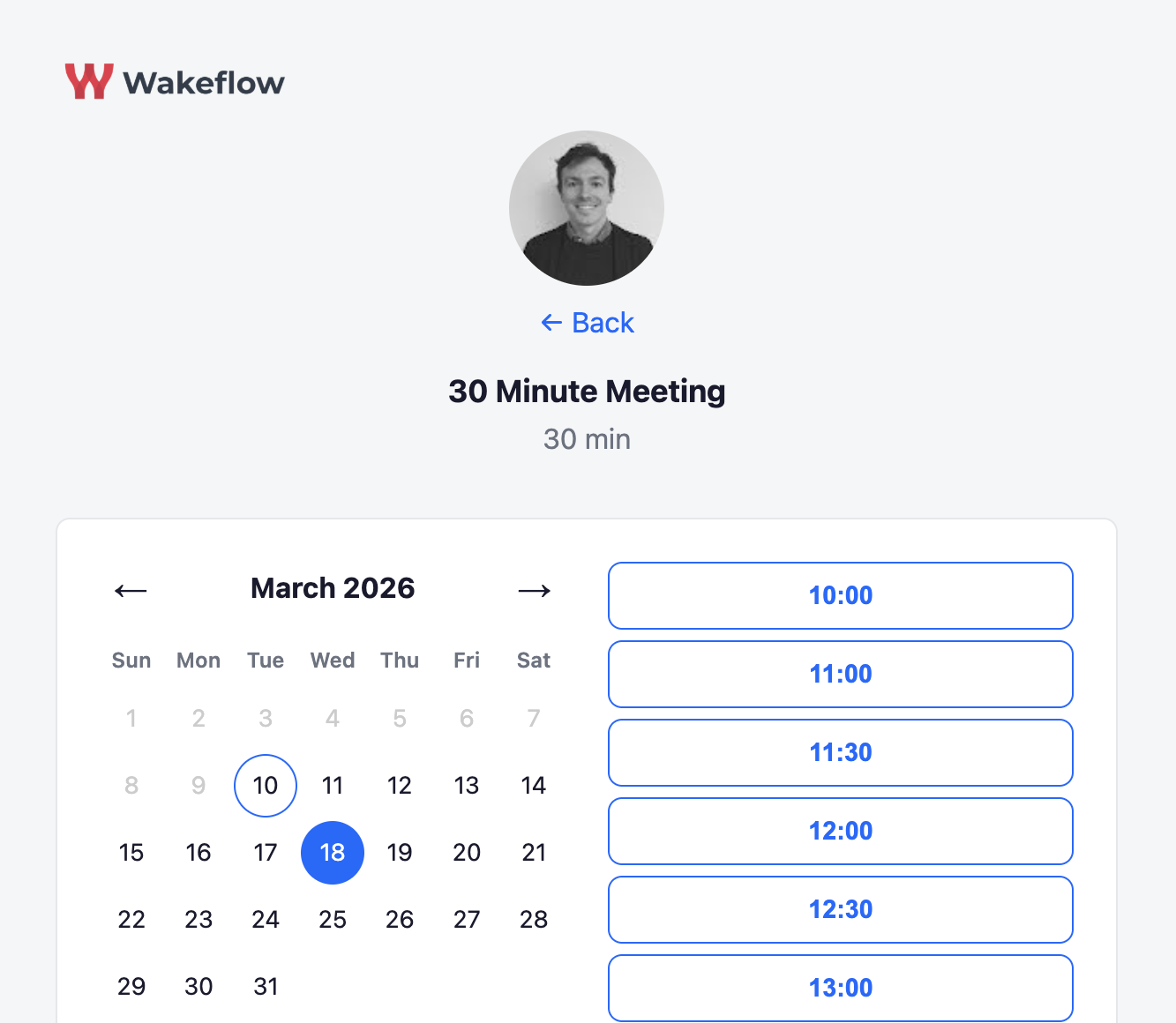
An easy one was Calendly. Nice, self-contained, easy place to start.
So I built it.
How it works
- I opened up Claude Code and simply told it to: "Build a Calendly Clone"
- It got 90% of the UI right on the first try. Four words turning into an application still blows my mind.
- There was a fair bit of debugging after that. It didn't invite the guest, didn't check my calendar for availability, and got timezones confused.
- But each bug was just a prompt to fix.
- Then I added payments via Stripe and now you can have half-price Calendly at calendar.wakeflow.io.
- And we're no longer spending on that.
- Stay tuned for the next SaaS.
The stack
- Claude Code: the AI pair programmer that wrote about 95% of the code, debugged API issues, and iterated on fixes in real time
- Stripe: subscription billing with checkout sessions and customer portal
- Express 5 + Node.js: backend API with ES modules
- Firebase Auth + Firestore: authentication and lightweight data storage
- Google Calendar API: single source of truth for availability and bookings
- Google Cloud Functions: serverless deployment
What surprised me
The hardest bugs weren't in the business logic. They were at the boundaries between systems.
A naive new Date('2026-03-09T13:30:00') silently parses as UTC, shifting displayed times by an hour in CET.
A created_at timestamp stored as "2026-03-09 10:26:05" with a space instead of a T caused Google's API to return 400, but the error was swallowed and the booking counter just stayed at zero.
These are exactly the kinds of bugs that would normally take a human developer hours to trace. Claude Code diagnosed them in seconds by querying the actual API responses and comparing formats.
Bigger picture
This is what building software looks like now.
A full-stack SaaS product with auth, payments, third-party API integrations, and production deployment got built and debugged in one sitting.
The role of the developer is shifting from writing code line by line to architecting systems and steering an AI that executes at speed.
The companies that figure out this workflow first will ship 10x faster than those still debating whether AI can "really" code.
It can.
Get in touch
If you're thinking about building a custom internal tool, replacing an expensive SaaS with something you own, or just want to see how AI-assisted development works in practice, get in touch.
I do this every day at Wakeflow and I'm always happy to chat about it or build something similar for your team.